
Best Acting Institute in Uttarakhand

Author name: nitesh22young@gmail.com

Actorkala Best Acting Institute in Uttarakhand
Uncategorized

Script Analysis for Actors – How to Approach a Script !

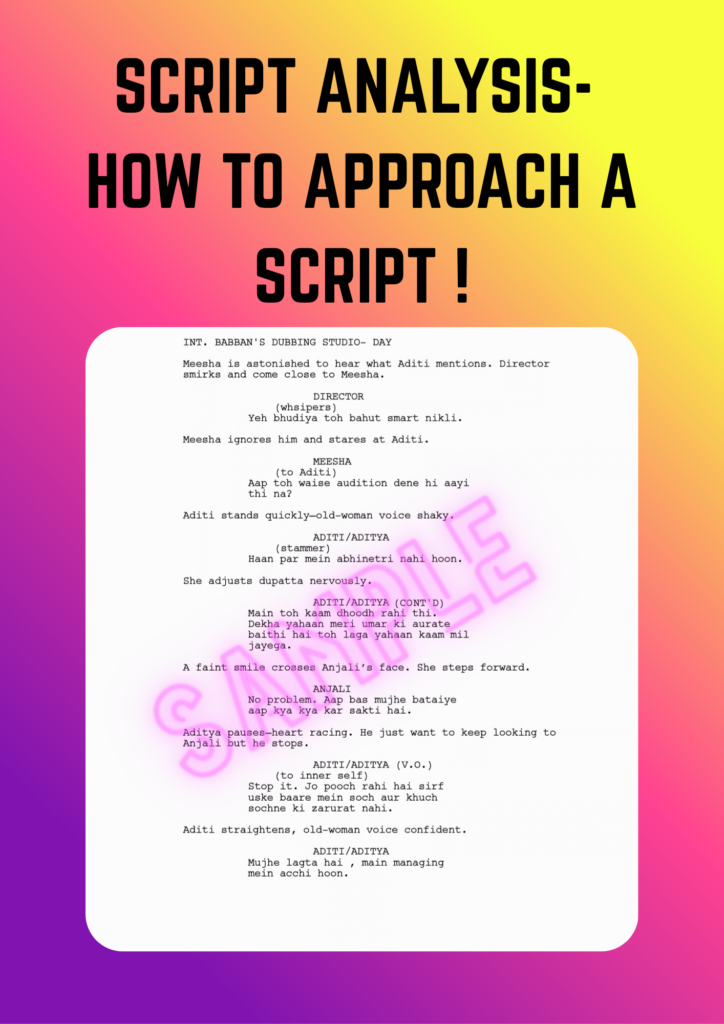
A Script is a written blueprint of a performance, (be it for a theatre show or a Television show or Webseries or for a feature film). It contains the story/plot, characters, dialogues, actions, dramas, time era & other important instructions for Actors, Directors & Cinematographers etc. It Outlines every detail needed to bring a story from an idea on paper to finished production on screen ! The same script when used for visual mediums like T.V. / Film / webseries is called Screenplay ! like how a script is visually shown on a Screen. For an actor, it is the foundation of performance, the emotional blueprint of a character, and the starting point of every believable portrayal of any character. A script provides clues about who a character is, what they want, and what emotional conflicts shape their decisions.  One of the first steps in script reading practice for actors is learning how scripts are structured. Every screenplay or stage script usually follows a format designed to communicate narrative, pacing, and visual storytelling. Actors must firstly learn to identify subtext in any script, i.e. the unspoken emotions and intentions hidden within scenes. A character may say one thing while emotionally meaning something entirely different. Recognising these layers is a critical part of script analysis for actors because authentic performances are built through emotional understanding rather than just memorizing and saying the lines alone coldly without any emotions ! Any good script gives basic information about what the entire Story or Plot is all about, Character & its inter-relation with other characters & Scenes ! The Actor’s 5 W’s + H method :- Who, What, When, Where, Why & How breaks down the character for deeper understanding & honest performance. An Actor must be ‘in the Moment’, be Truthful in his character for an Honest/Genuine performance ! He/She achieves this by multiple readings of Script only ! Learning this skill of being in the moment sets the difference between an untrained actor (who might be good in just rote learning) and a skilled trained professional Actor !   A trained Actor approaches any script by using different methods of Acting like Stanislavsky system, Method Acting, Meisner technique, Stella Adler technique, Chekov Technique, Physical theatre system, Improvisational acting, Indian classical Acting etc. depending on his/her preference of choice. There is no single technique that every actor must use. Professional training usually combines several approaches depending on the script, character, director, medium and performance style. For Actors, Learning how to read script effectively requires patience and repeated exploration. Professional actors rarely read a script only once. Instead, they revisit lines/scenes multiple times, discovering new emotional details with each reading. The first reading is usually focused on understanding the overall story. Actors observe the narrative arc, relationships between characters, and the emotional tone of the project. This helps them understand where their character fits within the larger story. The second reading becomes more analytical. Actors begin identifying objectives, emotional shifts, conflicts, and internal motivations. They start asking Questions to themselves like What does the character want? What’s the importance of this character? What are they hiding? What emotional changes occur within the scene? What’s the goal/purpose of this scene? Further readings focus on rhythm and emotional truth. Actors then explore nuances, pauses, pacing, silence and the natural flow of dialogue. At Actorkala, students are trained to approach scripts with curiosity and emotional honesty rather than rushing directly into memorisation/roting. This process helps actors build stronger emotional connections to their roles for a beautiful performance ! Consistent script reading practice for actors strengthens their performance quality & also creative instincts. The more actors bond with scripts, the more naturally they begin identifying emotional patterns, character arcs and dramatic tension. One of the most valuable aspects of script reading practice is understanding relationships between different characters. Human interaction drives storytelling, and actors must recognise how different human-relationships influence tone, energy, and emotional behaviour. Practising with a variety of scripts also helps actors become versatile performers. Reading scenes from drama, comedy, thriller, and romance enlightens the actors to different emotional rhythms and storytelling styles. Over time, this improves adaptability during auditions and performances. One of the biggest mistakes inexperienced actors make is they focus only on their own lines. Professional script analysis requires understanding the entire scene, including what other characters are experiencing emotionally. Reaction is equally important as dialogue delivery. Often, a powerful performance comes not from speaking but from listening truthfully and responding authentically. This is why actors must pay close attention to silence, and emotional tension, pacing etc. within scenes. Understanding how to read script also means recognising the writer’s intention. Every scene exists for a reason. Actors must ask themselves why a scene matters, what emotional shift occurs, and how the character changes because of it for a beautiful, believable performance ! Thus, We, At Actorkala prepare our students well on Script analysis and how to approach any script to perform with self belief & confidence !

HOW-TO-BECOME-AN-ACTOR
Uncategorized

How to Become An Actor !

Acting is an Art ! Lord Nataraj ( Mahadeva Shiva ) is the forefather of the entire range of “Kalas”( skills ) from Nritya(Dancing) to Performance Arts to Navrasas i.e.”the 9 main range of emotions” to Yoga asanas to Meditation, Observation, Expression & Martial Arts etc. The journey into acting can feel challenging, especially if you have no previous acting training or no industry connections. Many new beginners think how to start acting career in India and if, there is a clear path to entering the industry. An important question in their journey is, is acting a good career in India? While the industry is very competitive, many actors still build wholesome careers through their consistent training, networking, dedication, patience and persistence. Many people believe that acting is purely based on talent/luck or good looks…but the truth is that becoming an actor requires preparation, practice, and the right guidance ! Understanding what are the first steps to becoming an actor are, can make the path much clearer. Whether someone wants to work in films, web series, or theatre, the foundation of a successful acting career always begins with learning the craft. Becoming a famous actor in India is a dream for millions of aspiring people. From Bollywood and television to OTT platforms, theatre, advertisements, web series, regional cinema and short films, the Indian entertainment industry today offers many acting opportunities. However, acting is not simply about having a good face or getting a chance in a film, It is a professional craft that requires training, discipline, confidence, persistence and continuous improvement. Most people assume actors simply perform naturally in front of the camera but In reality, acting is a skill that must be developed over time. It involves understanding emotions, body language, voice control, and character’s psychology. For people who wonder how to become an actor in India, understanding the craft is the first step of the  starting point. Great actors across the world spend ‘years’ learning how to observe human behaviour and translate it into their authentic performances. This is why structured training plays an important role in shaping an aspiring actor’s abilities. Another important question for many beginners is how long does it take to become a professional actor? The answer to this varies for each person, but consistent training and practice are essential parts of the journey. For beginners, who want to start acting with no experience, the first step is to treat acting as a craft which must be learnt & perfected with time. One of the most important steps for anyone researching how to become an actor is receiving professional training. Acting schools help students to evolve & develop the tools required for performance, voice work, body awareness, improvisation, and character development. Training helps actors understand how to perform for both camera and stage, which require different techniques. Acting schools provide an environment where students can practice scenes, collaborate with other performers, and receive feedback from experienced mentors. Many aspiring actors ask how to start acting career. The answer lies in daily practice. Just like musicians and dancers train regularly, actors must as well practice  their skills even when they are not performing daily. Daily practice includes: These habits help actors stay connected to their craft and deepen their understanding of performance. Daily practice is one of the most important habits that strengthens acting ability over time. Acting for the camera is different from performing on stage. Film acting requires subtlety, emotional truth, being in the moment and strong screen presence. Beginners often feel nervous or self-conscious when they first perform in front of a camera. Therefore, Training and practice definitely help actors become more comfortable with this. Recording short monologues, practising scenes with other actors, and studying performances from experienced artists can help improve on-camera confidence. (This stage is also important for actors wondering how long does it take to become a professional actor, because gaining comfort in front of the camera often develops gradually through consistent experience.) Once actors begin developing their skills, they should start building a basic portfolio which usually includes: Casting directors often review basic portfolio of Actors before inviting them to auditions. A strong portfolio helps showcase an actor’s potential and range. For many beginners researching how to become an Actor, building a professional portfolio is one of the key steps toward entering the industry. Next, Auditions are an important part of every actor’s journey. Even experienced performers attend auditions regularly. For beginners, learning how to become an actor in India, auditions provide valuable learning opportunities. They help actors understand casting expectations, improve their preparation process & camera performance. And Rejection is common in the entertainment industry, but every audition helps actors grow and refine their craft. Many successful actors credit their growth to structured training. Acting schools create a space where performers can explore emotions, experiment with characters, and develop the discipline required for long-term success. For people asking is acting a good career in India, professional training often plays a major role in helping actors develop the confidence and skill needed to pursue this career seriously. Learning under experienced mentors also helps actors avoid common mistakes and build a stronger understanding of the craft. For aspiring actors, having talent alone is not enough ! It requires training which gives a clear foundation for growth. Beginning an acting career may feel overwhelming in the start, but every successful actor once started at the same point. With the right training, dedication, practice & mentorship, it is possible to develop the skills required to perform confidently on stage and screen. Understanding what are the steps to becoming an actor can help beginners enter the industry with clarity and direction. For those who are serious about how to become an actor professionally, structured training is the first step toward turning that passion into a career. If you’re interested in learning the craft and developing your acting skills, exploring professional acting courses for beginners can be a great way to begin your journey ! “Actorkala” Welcomes You !

hellp 500 x 500 px 400 x 400 px 400 x 400 px
Uncategorized

Acting As a Career !

Acting is an art which gives not only inner satisfaction of performing before the audiences or camera but since last decade, it has turned into a lucrative high paying profession for the trained, passionate acting professionals. Good news is The Indian entertainment industry has grown manyfold since its inception into one of the most dynamic and influential creative sectors in the world. And with the expansion of cinema, television, OTT platforms and digital content, acting has transformed into a practical and rewarding career choice for passionate individuals. However, beyond glamour, acting demands skill, discipline and qualities like emotional depth which can be cultivated through the right training and mentorship. Choosing acting as a career in India opens doors to many diverse opportunities. From feature films and television dramas to web series, theatre and advertisement commercials, the demand for skilled actors has never been higher. However, success in this field goes beyond talent alone because It requires an understanding of script, its subtext, performance techniques, character development, camera awareness, and the ability to adapt to different storytelling mediums. A structured learning environment can help aspiring actors bridge the gap between raw potential and professional excellence. This is where Actorkala, can play a transformative role. As India’s premier acting institute, it offers students a best designed curriculum designed to meet the evolving demands of the industry. The training focuses on every aspect of an actor’s craft from observation, voice modulation, body language, improvisation, creativity & discipline to script analysis and on-camera performances. We believe in practical approach such as students work in a professional studio environment, engage in real-time scene rehearsals and receive personalised feedback from faculty. This ensures they not only gain technical skills but also the confidence and space presence required to perform in front of an audience or camera. The institute also nurtures individuality, encouraging students to explore their own unique styles and emotional truth. The emphasis on discipline, creative expression, and professional ethics equips graduates to navigate the competitive entertainment landscape with resilience. If you envision yourself bringing characters to life, the stage and screen are waiting. With the right training, dedication, and belief in your craft, your journey in the world of acting can truly begin. The OTT platforms like Netflix, Amazon Prime, Sony Liv, Zee5, Amazon Max player, Jio Hotstar etc have recently opened many acting opportunities for freshers and experienced Actors in Webseries and Webfilms. And regional cinema also continues to grow year on year. Advertising is another important field for actors example Television commercials, digital advertisements, corporate films, brand videos, music videos & social media reel campaigns require Actors. The demand for actors has also increased in Short films, youtube series, Podcasts, educational videos etc. Theatre too is an old pillar of acting and it gives actors opportunities to hone and refine their skills, body movements, voice modulation, memorization of long scrips, improvisation, stage presence & confidence. Many successful Actors have been associated with theatres. One big misconception about acting is that it’s all about simply looking attractive or becoming famous but reality is, it’s an art which requires tools to perform even in the crowd of 1000 people standing before you. Tools such as discipline, patience, continuous learning, emotional maturity, observation and strong communication skills. An actor must learn how to understand a character, analyse a script, listen to Director’s instructions carefully, listen to fellow performers, respond naturally, control physical movements, use the voice effectively, and express their emotions truthfully, by being in the moment ! The Camera captures even the slightest facial expressions and body movements. Camera acting also requires understanding framing, continuity, eyelines, marks and subtle expressions. Actors also need to understand rejections as they are a part & parcel of Job. Auditions are a regular part of the profession and even talented actors may not be selected for many roles. Rejection does not mean that an actor lacks talent. Casting decisions depend on age, appearance, character requirements, language, height, personality, availability and many other factors. Therefore, Actors must also learn to develop patience also and staying positive all the time. There is no compulsory educational qualification requirement for becoming an actor, but professional training can significantly improve an actor’s abilities. Acting schools, theatre groups, acting and its related workshops, performing-arts programmes can provide well defined training. However, A student may pursue theatre, performing arts, drama, film studies or related programmes while simultaneously gaining practical experience through theatre and independent projects. A good acting curriculum may include various acting techniques, improvisation, voice and speech, diction, body movement, observation, memory skills, theatre, camera acting, character development, script analysis, audition preparation tips and scene work. Training can also help actors develop confidence and overcome stage or camera nervousness. Auditions are the gateways to many professional acting opportunities. Actors may be called for auditions through casting agencies, casting directors, production houses, theatre groups, personal networks etc. A professional actor should maintain updated photographs, a suitable portfolio, acting resume and an acting showreel demonstrating performance ability. Audition preparation involves understanding the character, learning the scene lines, and being ready to take direction. Actors should also be cautious about fraudulent casting offers. Genuine professional opportunities do not require unreasonable payments merely for guaranteeing a role. Social media popularity and acting ability are Not the same thing. An actor should focus on developing genuine craft rather than simply chasing views and followers. Acting as a career can be a viable option in India for individuals who possess talent, dedication, discipline and the willingness to continuously learn & upskill themselves. The industry today offers far more avenues than the traditional film-and-television model. Theatre, cinema, television, OTT platforms, advertising, digital media and independent productions have created a wide professional career model. However, success in acting rarely happens overnight. It is a craft that develops through practice, observation, training, experience, patience and perseverance. An aspiring actor should therefore focus not only on getting opportunities but also on becoming a better performer holistically ! Welcome to the World of Acting !

Scroll to Top